
Nervous System Regulation for Manifesters and Stargazers
Discover practical techniques for nervous system regulation. Learn quick practices to reduce stress and boost your well-being today!
Share this article
Nervous system regulation is your body’s capacity to adapt to stress, maintain homeostasis, and return to baseline after a challenge. You don’t need to feel calm all the time. You need to be able to shift. Three micro-practices you can try right now:
- Physiological sigh: Inhale fully through your nose, then sneak in a second quick inhale on top of it, then exhale slowly through your mouth. Two rounds. Done in under 30 seconds, short breath patterns like this produce measurable reductions in arousal.
- Extended exhale: Inhale for 4 counts, exhale for several counts longer than the inhale. Repeat for 2 minutes. The longer out-breath activates the parasympathetic branch directly.
- Sensory orientation: Slowly scan the room. Name five things you can see, four you can touch, three you can hear. This grounds your attention in present-moment safety signals.
Pro Tip: These tools work best as complements to sleep, movement, and nutrition, not replacements. Quality sleep alone is one of the strongest drivers of nervous system health.
Table of Contents
- What the autonomic nervous system actually does
- Core practices you can build a routine around
- How to personalize practices to your birth chart
- How to measure whether your practices are working
- Safety, trauma sensitivity, and when to get professional help
- A 6-week plan combining somatic practice with cosmic timing
- Diet, sleep, and lifestyle factors that support nervous system balance
- Key Takeaways
- Why somatic regulation changed how I think about manifestation work
- The Highesttimeline Manifestation Academy brings this all together
- Further reading and sources
What the autonomic nervous system actually does
The autonomic nervous system (ANS) controls involuntary processes: heartbeat, blood pressure, respiration, and digestion. It has three divisions:
- Sympathetic: Mobilizes you. Releases epinephrine, raises heart rate, redirects blood to muscles. The “gas pedal.”
- Parasympathetic: Recovers you. Slows heart rate, promotes digestion, lowers cortisol. The “brake.”
- Enteric: Manages digestion through roughly 100 million neurons in the gut wall, connected to the brain via the vagal axis.
Regulation isn’t about staying in parasympathetic mode permanently. As neuroscientist Dr. Ramon Velazquez explains:
The vagus nerve is the physical highway for that flexibility. It modulates heart rate, digestion, and inflammatory signaling, which is exactly why breath, cold exposure, and vocalization change your body state so quickly. Dr. Stephen Porges’ polyvagal theory adds another layer: the ventral vagal system responds to social cues, meaning a calm voice or trusted presence can actively signal safety and downregulate an activated system.
Core practices you can build a routine around
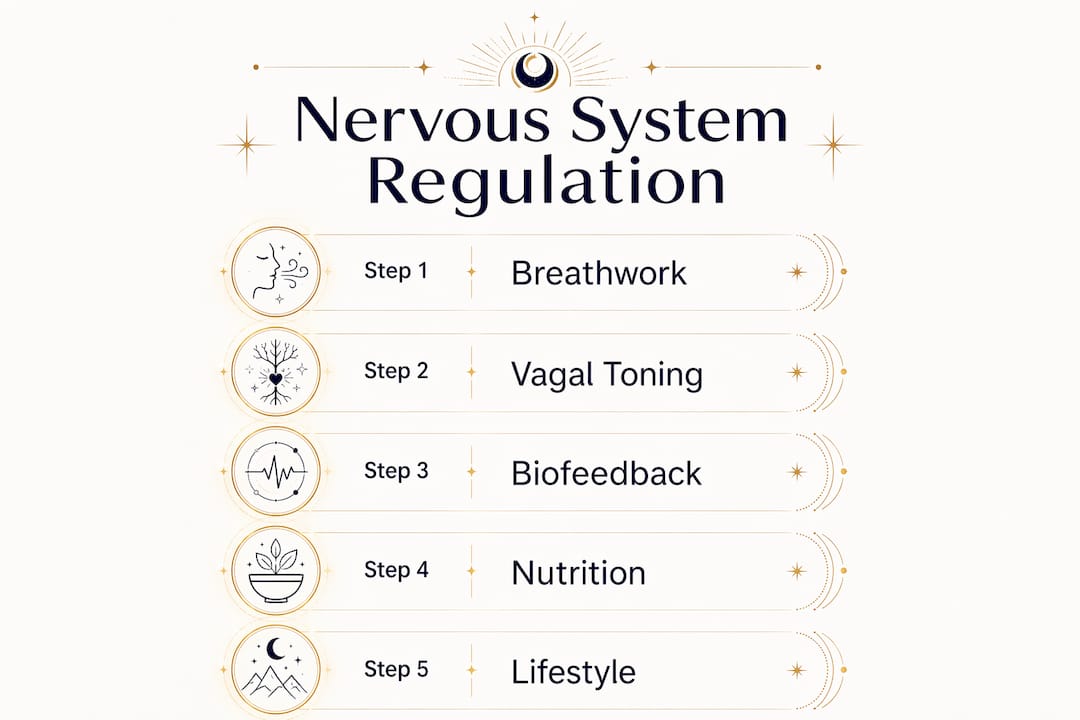
Breathwork protocols
- Physiological sigh (described above): Use at the start of any ritual or when you feel activation spike.
- Box breathing: Inhale 4 counts, hold 4, exhale 4, hold 4. Repeat 4–6 cycles. Sit upright, shoulders relaxed.
- Paced exhale breathing: Inhale 4 counts, exhale 6–8 counts. Use for a few minutes before sleep or meditation.
Grounding and movement
- 5-4-3-2-1 sensory scan: Name five things you see, four you can touch, three you hear, two you smell, one you taste.
- Soft gaze and slow head turns: Let your eyes go slightly unfocused. Turn your head slowly left and right. This activates the orienting reflex and signals “no threat.”
- Rhythmic bilateral movement: A 60–90 second walk with deliberate arm swing, or bilateral tapping (alternate tapping each knee) while seated. Rhythm itself is regulating.
Vagal toning
Vagal toning practices include humming, gargling with water for 30 seconds, and cold-face splashes (brief exposure to cold water on the face). Aim for one or two of these daily. Skip cold-face exposure if you have a cardiac condition or known vasovagal syncope.
HRV biofeedback
Short, HRV-guided sessions of 2–5 minutes can accelerate learning of vagal control when paired with consistent lifestyle habits. Use a pulse oximeter app or a wearable that reports HRV. Take readings at the same time each morning, in the same breathing state, for consistency. Stop any session if you feel dizzy, chest-tight, or more anxious than when you started.
How to personalize practices to your birth chart
Three rules of thumb for chart-informed scheduling:
- Lunar timing: Use waxing moon phases to initiate new practices (start the 6-week plan at a new moon). Use waning phases for release-oriented breathwork and reflection.
- Modality fit by element: Air signs tend to respond well to breath and vocal toning. Earth signs often do better with grounding and rhythmic movement. Water signs benefit from sensory grounding and slow exhale breath. Fire signs tend to prefer dynamic movement and short, intense breathwork bursts.
- Transit awareness: On days with heavy Saturn or Pluto transits, scale back intensity. Use orienting and soft movement instead of cold exposure or intense breathwork.
A practical example: someone with a strong Moon-Neptune placement in their chart often experiences heightened sensitivity in the hours before sleep. Scheduling a nightly 5-minute paced exhale practice, followed by a brief journaling ritual timed to the waxing or waning moon, gives that sensitivity a container rather than letting it spiral.
Pro Tip: Track your HRV readings alongside your moon phase and transit notes for 4–6 weeks. Patterns in the data will tell you more than any rule of thumb.
- Note the current moon phase each morning.
- Log your morning HRV or a 1–10 subjective energy score.
- Record which practice you used and for how long.
- Review weekly for correlations between chart timing and physiological markers.
How to measure whether your practices are working
What HRV actually tells you: Heart rate variability measures the millisecond variation between heartbeats. Higher resting HRV generally correlates with greater parasympathetic tone and stress resilience. It varies significantly by age and baseline fitness, so compare your own trend over time rather than against population averages.
Subjective markers matter just as much:
- Sleep quality improving (falling asleep faster, fewer wake-ups)
- Ability to shift out of a stress response within minutes rather than hours
- Less baseline muscle tension in jaw, shoulders, and gut
- Improved digestion
- Clearer focus during meditation or manifestation rituals
Realistic timelines: Immediate state shifts happen in seconds to minutes with breathwork. Baseline changes in resting HRV and stress reactivity typically require 4–8 weeks of consistent daily micro-practice. Combine objective HRV data with subjective markers for the clearest picture.
| Marker | What to track | When to expect change |
|---|---|---|
| Morning HRV | Daily reading, same time and posture | Trend visible after 4–6 weeks |
| Sleep onset | Minutes to fall asleep | 2–4 weeks with consistent evening practice |
| State-shift speed | Minutes to return to baseline after stress | 4–8 weeks |
| Ritual focus | Subjective clarity during manifestation work | 2–4 weeks |
Safety, trauma sensitivity, and when to get professional help
Not every practice is right for every person at every moment. Stop and seek professional support if you experience:
- Panic attacks that worsen with breathwork
- Fainting or near-fainting with cold exposure
- Known cardiac arrhythmia or seizure history
- Severe dissociation during or after somatic practices
For anyone with a trauma history, shorter exposures work better than longer ones. Orient first (sensory scan, soft gaze) before moving into breath holds or cold exposure. Co-regulation, sitting near a calm, trusted person, is often more effective than solo practice when activation is high.
“When the nervous system is in extreme dysregulation, cognitive interventions can fail. Bottom-up stabilization through breath, cold, and orienting creates access for therapy and ritual work.” — Stanford Lifestyle Medicine
Pro Tip: If you’re working with a therapist, share your somatic practice log with them. Supervised biofeedback is available through licensed psychologists and some physical therapists for anyone with complex trauma or cardiac concerns.
A 6-week plan combining somatic practice with cosmic timing
Weeks 1–2: Foundation
- Morning: 2 physiological sighs upon waking, then a 5-minute paced exhale session.
- Evening: 5-4-3-2-1 sensory scan before sleep.
- Lifestyle anchor: Prioritize 7–9 hours of sleep and one 20-minute walk daily.
- Chart note: Start at the new moon. Log HRV and moon phase daily.
Weeks 3–4: Vagal toning and movement
- Add daily humming or gargling (30 seconds each).
- Extend movement to 10–20 minutes of rhythmic bilateral activity.
- Add one cold-face splash per day if no contraindications apply.
- On heavy transit days, replace intense practices with orienting and soft gaze only.
Weeks 5–6: Integration with manifestation rituals
- Time a 10-minute breathwork session to the waxing moon (intention-setting) and a reflective body scan to the waning moon (release).
- Add a 5-minute quantum visualization or journaling ritual immediately after breathwork, while the nervous system is in a regulated state.
- Review your 6-week HRV and subjective marker log. Note which chart-timed sessions produced the clearest shifts.
The Highesttimeline Manifestation Academy curriculum maps directly onto this arc. Modules covering somatic practice and ancestral pattern work align with weeks 1–4. The advanced breathwork and quantum visualization modules align with weeks 5–6. Live weekly calls and optional group breathwork events give you the co-regulation layer that solo practice can’t fully replicate.
| Week focus | Academy module alignment | Optional add-on |
|---|---|---|
| 1–2: Breath and sleep | Somatic practice foundations | Live activation event |
| 3–4: Vagal toning and movement | Ancestral healing and energy mastery | Group breathwork session |
| 5–6: Manifestation ritual integration | Advanced breathwork and quantum visualization | Live weekly call |
Diet, sleep, and lifestyle factors that support nervous system balance
Sleep is the non-negotiable foundation. Chronic sleep restriction keeps cortisol elevated and blunts HRV gains from any breathwork practice. Aim for consistent sleep and wake times to stabilize your circadian rhythm and support parasympathetic recovery overnight.
Nutrition shapes the gut-brain axis directly. The enteric nervous system communicates with the vagus nerve constantly, so a diet rich in fiber, fermented foods, and omega-3 fatty acids supports the vagal tone you’re building with breathwork. Minimize ultra-processed foods and alcohol, both of which increase sympathetic activation and disrupt sleep architecture.

Movement and social connection round out the picture. Regular rhythmic exercise, even a daily 20-minute walk, reduces baseline stress hormones. And proximity to calm, trusted people is not a soft benefit. Polyvagal theory identifies social co-regulation as one of the most direct pathways to ventral vagal activation. For manifestation-focused practitioners, this means your community and your rituals are both physiological tools.
Key Takeaways
Nervous system regulation is the capacity to shift flexibly between arousal, focus, and recovery states, and consistent daily micro-practices produce measurable baseline changes within 4–8 weeks.
| Point | Details |
|---|---|
| Regulation means flexibility | The goal is shifting between states efficiently, not staying permanently calm. |
| Start with breath | The physiological sigh and paced exhale produce rapid state shifts in seconds to minutes. |
| Measure with HRV and subjective markers | Track morning HRV trends over 4–6 weeks alongside sleep quality and ritual focus. |
| Personalize to your chart | Match practice modality and timing to your element and lunar phase for compounding effect. |
| Highesttimeline Manifestation Academy | The six-module curriculum maps somatic regulation and birth-chart decoding onto a structured, personalized practice arc. |
Why somatic regulation changed how I think about manifestation work
Most manifestation frameworks treat the mind as the primary lever. Set the intention clearly enough, visualize vividly enough, believe hard enough, and results follow. What that model misses is that a dysregulated nervous system actively filters out the signal. When your body is running a low-grade threat response, your attention narrows, your creativity contracts, and your rituals feel hollow because physiologically, you’re not present for them.
The shift I’ve seen, both in the research and in the Highesttimeline approach, is treating somatic regulation as the prerequisite rather than the afterthought. Breathwork before visualization isn’t a warm-up. It’s the condition that makes visualization neurologically accessible. A body that can shift states quickly is a body that can hold an intention without immediately collapsing it under anxiety or doubt.
The birth-chart layer adds something the generic wellness world ignores: timing and temperament. Not every practice works equally for every person, and not every moment in a cycle is equally receptive. That specificity is what makes the difference between a routine you drop in week two and one that compounds over months.
The Highesttimeline Manifestation Academy brings this all together
If you’ve read this far, you already know that regulating your nervous system and working with your cosmic blueprint aren’t separate projects. They’re the same project. Highesttimeline’s Manifestation Academy is built on exactly that premise: a six-module curriculum that decodes your birth chart, integrates somatic practice and ancestral healing, and gives you advanced breathwork and quantum visualization tools in a structured sequence. Weekly live calls provide the co-regulation layer. Optional live group breathwork events deepen the somatic work. New members receive personalized chart intake so the curriculum fits their actual energetic blueprint, not a generic template. The program is backed by a six-month money-back guarantee.
These tools work best alongside the lifestyle foundations covered above: consistent sleep, whole-food nutrition, and regular movement. The Academy is the guided structure. You bring the fundamentals. Visit Highesttimeline to see the full curriculum and start with your birth chart.
Further reading and sources
The claims in this article draw from the following sources. Each is worth bookmarking for deeper study.
- NCBI StatPearls: Autonomic Nervous System — Peer-reviewed anatomy reference covering sympathetic, parasympathetic, and enteric divisions, neurotransmitter mechanisms, and vagus nerve function. Use this for the physiology baseline.
- Lifehacker: How to Actually Regulate Your Nervous System — Practitioner-sourced explainer featuring Dr. Ramon Velazquez’s flexibility framing and lifestyle-first recommendations. Good for the clinical definition and flexibility model.
- University of Miami Health (UHealth Collective) — Clinical guidance on vagal toning practices and HRV biofeedback, including contraindications. Useful for the how-to and measurement sections.
- Simply Psychology: Nervous System Regulation — Covers polyvagal theory, co-regulation, and physiological sigh research. Strong on the social and breath-based mechanisms.
- Stanford Lifestyle Medicine: Survival Mode — Explains why bottom-up stabilization precedes cognitive work and introduces the concept of cumulative transition rituals. Essential for the safety and sequencing sections.
- Cleveland Clinic: Autonomic Nervous System — Accessible clinical overview of ANS structure, function, and disorders. Good for readers who want a plain-language anatomy reference.
- Harvard Health: Understanding the Stress Response — Detailed explanation of the HPA axis, cortisol cascade, and chronic stress effects. Use this to understand why regulation matters beyond acute stress.
This article is general information, not medical or psychological advice. Consult a qualified clinician for guidance specific to your health history, particularly before beginning cold exposure, intensive breathwork, or HRV biofeedback if you have a cardiac condition, seizure history, or trauma background.